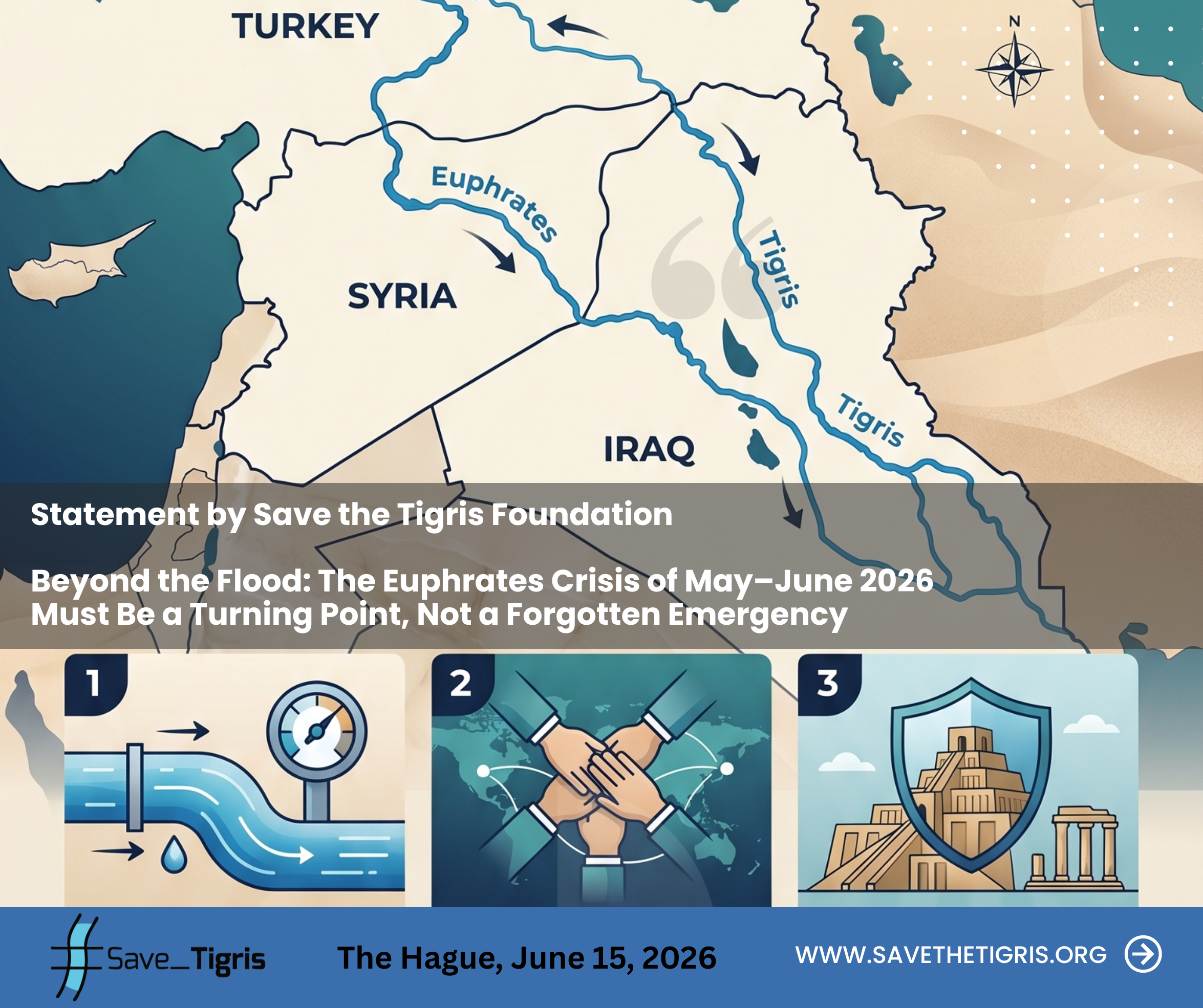
Statement by Save the Tigris Foundation
The Hague, June 15, 2026
Our alarm is growing over the catastrophic flooding of the Euphrates River in late May and early June 2026, which devastated communities in eastern Syria—destroying thousands of dunams of wheat crops, displacing families, collapsing bridges, and disabling more than sixty water pumping stations (AFP, 2026). Simultaneously, water levels in Iraq’s Euphrates rose significantly following a controlled release from Turkey’s Atatürk Dam, the first such release in seven years and only the third in 22 years (Kurdistan24, June 2026).
Syrian Minister of Energy, Mohamed Al-Bashir, stated: “The warning from Turkey regarding the rising water levels was late, and these water releases from Turkey toward Syria are the first of their kind in 30 years.” Raed Al-Saleh, Minister of Emergency and Disaster Management, confirmed that the recorded damage in Deir ez-Zor exceeds even that of Raqqa. Iraqi authorities learned of the release after the fact and were left to scramble for coordination (Kurdistan24, 2026). Local authorities in Anbar Governorate announced that “Three bridges (Al-Huwayjah, Al-Baydah, and Al-Dughaymah) went out of service, and the ‘Sa’da’ water project stopped following the flood wave”
Today, the situation is under control. Syria and Iraq managed the water waves despite the damage and the panic. But that is not a cause for relief. It is a cause for alarm. We do not issue this statement to report an ongoing crisis. We issue it to demand that the governments of Turkey, Syria, and Iraq act before the next one arrives.
This crisis was not a natural disaster. It is the direct consequence of a single, enduring failure: the absence of a complete, binding trilateral agreement among Turkey, Syria, and Iraq for the management of the Euphrates-Tigris river system. For more than three decades, the three riparians have negotiated, convened technical committees, and signed temporary bilateral arrangements—but they have never taken the final step of concluding a permanent, enforceable, trilateral framework.
The Existing Protocols: Valuable Foundations That Must Be Respected and Completed
The history of water negotiations in the Euphrates-Tigris basin has produced two important bilateral protocols. They are necessary starting points that must be respected, enforced, and built upon:
- The 1987 Protocol between Turkey and Syria: A temporary arrangement in which Turkey undertook to release a yearly average of more than 500 m³/second at the border. The protocol states that this applies “until the final allocation of the waters of Euphrates among the three riparian countries.” More than three decades later, that final allocation remains unfinished.
- The 1990 Protocol between Syria and Iraq: Provides that 58 percent of Euphrates waters coming from Turkey shall be released to Iraq by Syria. A clear, functional allocation agreement between the two downstream riparians.
For more than thirty years, these protocols have served as interim measures. They were never meant to be final. Neither provides for real-time notification of dam releases, binding dispute resolution, climate adaptation, or protection of the river’s cultural and natural heritage. The 2026 floods did not expose the failure of these protocols. They exposed the consequences of leaving them unfinished for three decades.
Three Fundamental Failures Exposed
First Failure: Waiting for Crises Instead of Preventing Them
The 2026 floods were preventable. The 1987 protocol, as a temporary arrangement, was never designed to provide binding mechanisms for real-time notification or dispute resolution. The 1990 protocol cannot function properly when upstream dam releases are uncoordinated or unannounced. A “Ten-Year Agreement” between Iraq and Turkey—the Framework Agreement for Cooperation in the Water Field, signed in April 2024 and entered into force in November 2025—remains too general. It aims at fair use and joint management, but has not led to concrete trilateral coordination.
Second Failure: Seasonal Management Instead of Long-Term Policy
Water management in the Euphrates basin is reactive. When drought strikes, upstream states ration flow. When rains fill reservoirs, they release water downstream with little warning. Downstream states scramble, then return to silence. This seasonal, crisis-driven approach does not protect the river’s ecological health, provide predictable water for farmers, or allow cities to plan their supply.
Third Failure: Excluding Local Communities, Civil Society, and River Protection
Local communities along the Euphrates—from Raqqa and Deir ez-Zor to Anbar—are the first to suffer when floods come and the last to be consulted. Local authorities, farmers, and civil society are systematically excluded from transboundary water decisions.
Furthermore, the existing protocols say nothing about protecting the river’s cultural and natural heritage. The Euphrates is not only a water source; it is a cradle of civilization, home to archaeological sites, unique ecosystems, and biodiversity that have survived for millennia. Any future agreement must include binding commitments to preserve this heritage.
The Mesopotamia Water Forum: A Grassroots Demand for Multilateral Collaboration
In October 2025, Save the Tigris Foundation organized the Mesopotamia Water Forum in Diyarbakır. More than 260 participants from Turkey, Iraq, Syria, and Iran came together—civil society representatives, water experts, farmers, local officials, and activists. They demanded a seat at the table. They declared that unilateral management, fragmented agreements, and the exclusion of local voices are no longer acceptable. They insisted that multilateral collaboration is an urgent need, not a distant aspiration.
Our Demands: Urgent and Immediate Action
We, Save the Tigris Foundation, call upon the governments of Turkey, Syria, and Iraq to:
- Respect and enforce the existing 1987 and 1990 protocols as valuable foundations that no unilateral action should undermine.
- Fulfill the promise of the 1987 protocol by converting this temporary arrangement into a permanent, binding trilateral treaty.
- Build upon the 1990 Syria–Iraq protocol by incorporating its 58/42 allocation into a broader trilateral framework that includes Turkey.
- Establish permanent trilateral coordination with real-time data sharing, joint monitoring, and mandatory advance notification of all dam releases.
- Adopt a long-term binding policy moving beyond seasonal crisis management, with climate-adjusted allocations and ecological flow guarantees.
- Formally involve local authorities and civil society in river management decisions, including mandatory consultation and public disclosure of planned dam operations.
- Include binding provisions for cultural and natural heritage protection for archaeological sites, ecosystems, and biodiversity along the Euphrates.
- Revive the Joint Technical Committee (JTC) with a new mandate for real-time data sharing, advance notification, joint monitoring, and dispute resolution.
- Move beyond the old JTC deadlock by accepting a pragmatic compromise: an immediate trilateral framework for the Euphrates while commencing joint studies on the entire Euphrates-Tigris system.
- Recognize the Mesopotamia Water Forum as a legitimate expression of public will and respond to its core demand for multilateral collaboration.
- Provide immediate humanitarian assistance to affected communities in Syria and Iraq, including farmers who lost harvests, displaced families, and local water authorities restoring damaged infrastructure.
We announce our readiness to come to Ankara, Damascus, and Baghdad with experts and specialists—including representatives of the Mesopotamia Water Forum—for further discussion. This statement is a demand for accountability, but also an offer of partnership: one in which the temporary arrangements of 1987 and 1990 finally mature into a permanent trilateral treaty and where the river’s heritage is protected, and the people of the Euphrates are treated as partners, not as victims.
For more information, contact the international coordinator:
[email protected]
Website: https://savethetigris.org
Facebook: https://www.facebook.com/save.the.tigris.stc