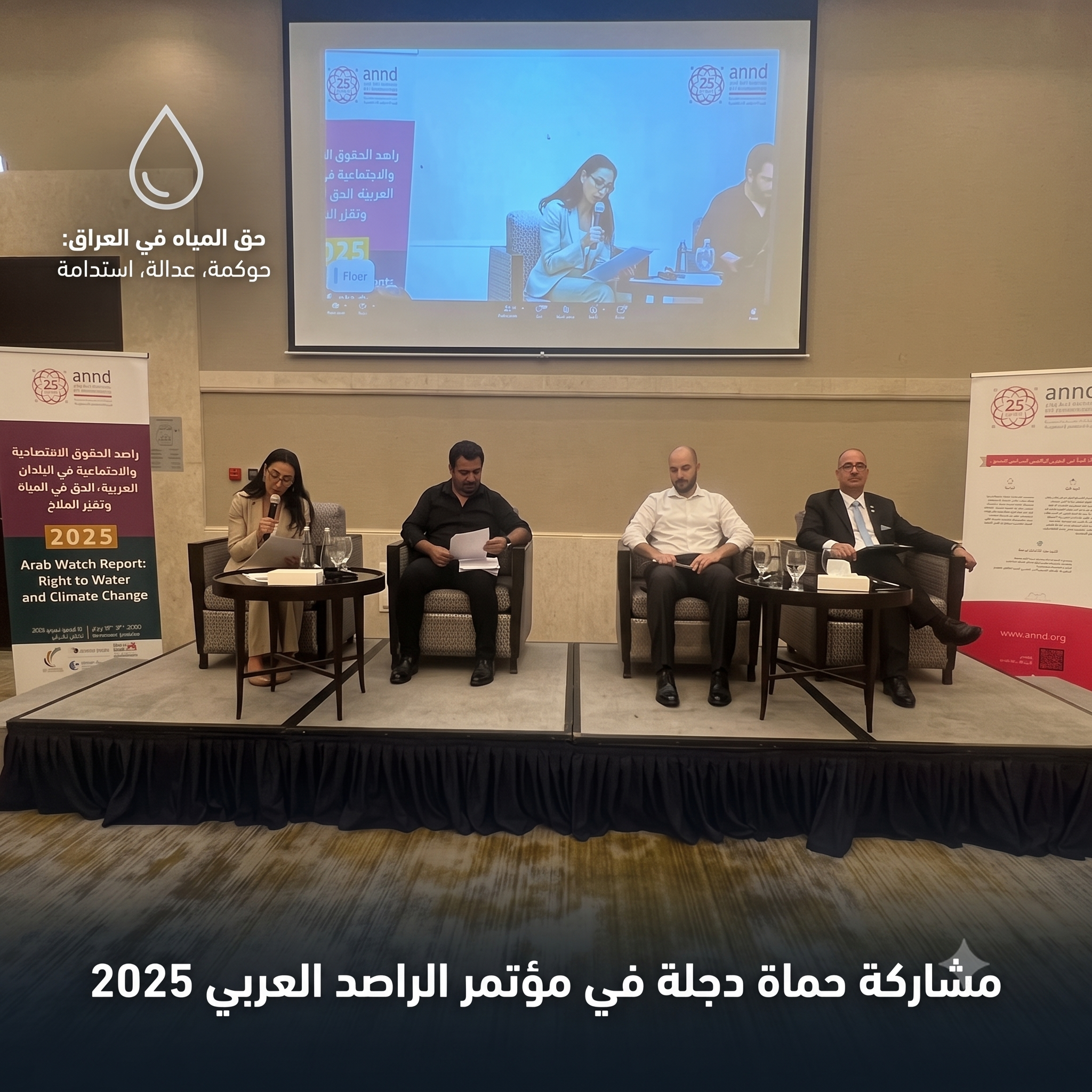
The Humat Dijlah Association (Tigris Protectors) participated in the conference dedicated to the launch of the Arab Watch Report 2025 – The Right to Water in Iraq. The event was organized by the Arab NGO Network for Development (ANND) in the Jordanian capital, Amman, with the participation of a distinguished group of experts, researchers, representatives of civil society organizations, and regional institutions concerned with water issues and sustainable development. This conference comes within the framework of ongoing efforts to promote the right to water as a fundamental human right, and to shed light on the challenges facing water resources management in the Arab region.
One of the conference’s primary axes discussed the governance frameworks and economic policies affecting water resources management, and their role in achieving sustainable and equitable water management. Participants also addressed the importance of building national and regional policies based on the principles of good governance. This aims to enhance the efficiency of water resources management and ensure water security in light of the growing challenges posed by climate change, population growth, and declining water revenues in many Arab countries.
During the conference sessions, colleague Naseer Baqer reviewed the reality of water governance in Iraq, explaining that the water crisis facing the country is no longer confined to the decline in water inflows from source countries. Rather, it has also become linked to a set of internal challenges related to management, planning, legislation, and implementation mechanisms. He pointed out that achieving equity in access to water requires institutional reform that strengthens coordination among government entities, raises the efficiency of water resources management, and ensures a more equitable and sustainable distribution of water across different sectors and regions.
The intervention also focused on the importance of strengthening the role of the Iraqi negotiator in managing the regional water file, considering it one of the most strategic files impacting the future of Iraq. Dealing with shared water issues requires a unified national vision based on international law, promoting dialogue and cooperation with neighboring countries to protect Iraq’s water rights and guarantee its fair shares of transboundary waters.
In the same context, Baqer emphasized that addressing internal challenges is no less important than diplomatic efforts. He stressed the need to develop legislation related to water resources management in line with current changes, activate law enforcement mechanisms to curb violations on rivers and watercourses, and enhance accountability and oversight. Additionally, he called for adopting economic and environmental policies that support the efficient use of water in the agricultural, industrial, and service sectors.
He noted that dealing with water should transcend being merely a service file to become a sovereign and strategic file directly linked to water, food, and environmental security, constituting one of the pillars of stability and sustainable development in Iraq. Furthermore, adopting a comprehensive national vision for water management would enhance the country’s capacity to adapt to the impacts of climate change and mitigate the economic and social risks resulting from water scarcity.
The participation of Humat Dijlah in this conference marks the culmination of the efforts exerted by the association over the past year in preparing the Arab Watch Report 2025 on the Right to Water in Iraq: Opportunities and Challenges. The report monitored the reality of the right to water from a human rights and developmental perspective, reviewing the most prominent institutional, legal, and environmental challenges facing the water sector. It also presented a set of recommendations aimed at promoting good governance, improving water resources management, and supporting public policies that guarantee the protection of all citizens’ right to access water in a fair, safe, and sustainable manner.
This participation reinforces Humat Dijlah’s keenness to continue its role in supporting national and regional dialogue on water issues, and contributing to knowledge production and policymaking. This contributes to building a more efficient and sustainable management of water resources, and secures the right of current and future generations to obtain water as a foundation for life, development, and stability.